

Quick answer
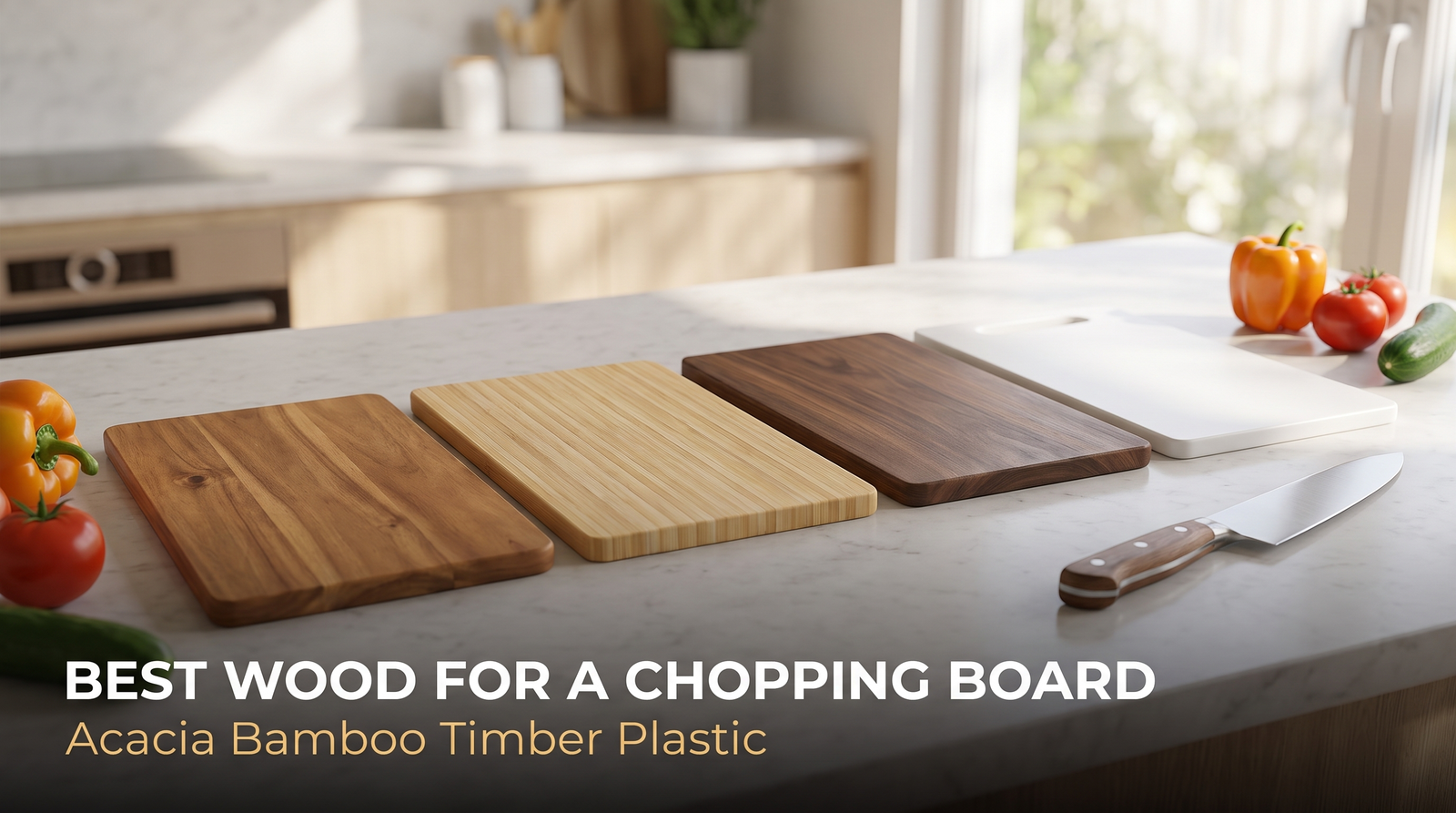
The best wood for a chopping board is acacia. It is hard enough to resist knife scarring but soft enough to spare your blade, it handles moisture well, and it costs less than maple or walnut. Bamboo is the cheapest option but it is glued, it delaminates, and the silica in it wears knives down faster. Plastic is dishwasher safe but scars easily and sheds microplastics into your food. For most Australian kitchens: acacia for daily use, bamboo only if budget decides it, plastic kept for raw meat if you want a board you can sanitise in the machine.
Key takeaways
- Acacia lands in the sweet spot. Acacia mangium, the species used in most homewares, measures 1,430 lbf on the Janka hardness scale — just under hard maple at 1,450 and above red oak at 1,290 (The Wood Database).
- Bamboo does not dull knives because it is hard. It dulls them because it is abrasive. Bamboo grows microscopic silica deposits called phytoliths, which sit around 7 on the Mohs scale — harder than any kitchen knife steel. They work like very fine sandpaper on your edge.
- Wood is not the less hygienic choice. UC Davis research found bacteria placed on wooden surfaces were drawn into the fibres and died there, while bacteria on knife-scarred plastic survived washing (Cliver, UC Davis).
- Plastic boards shed measurable microplastics. A 2023 study in Environmental Science & Technology estimated 7.4–50.7 grams per person per year from a polyethylene board (ACS).
- Never use vegetable oil on a board. It goes rancid and the board starts to smell. Food-grade mineral oil only.
- The water test tells you when to oil. Flick a few drops on the surface. Beads up, it is fine. Soaks straight in, it is thirsty.
This article covers
- What makes a good chopping board
- Acacia — the best all-rounder
- Bamboo — cheap, but hard on knives
- Other timbers worth knowing
- Wood vs plastic — which is actually more hygienic?
- Side-by-side comparison
- How to care for a wooden chopping board
- The verdict for Australian kitchens
- Frequently asked questions
- Sources
What makes a good chopping board
Four things decide it, and they pull against each other.
Hardness. A board that is too soft gets carved up and holds food in the grooves. A board that is too hard blunts your knives. The useful range sits around 1,100 to 1,500 lbf on the Janka scale — hard enough to take daily chopping, soft enough to let the blade sink in slightly instead of bouncing off.
Knife-friendliness. This is not the same as hardness, and most guides get it wrong. Abrasiveness matters more. A board can be moderately soft and still eat your edge if there are hard mineral particles in it.
Moisture behaviour. Timber moves when it gets wet and moves again as it dries. A board that absorbs water unevenly will cup, warp or split at the glue lines.
Care. Every wooden board needs hand washing and occasional oiling. If you will not do that, be honest with yourself and buy plastic.
Acacia — the best all-rounder

Acacia is what we sell, so take the recommendation with that in mind — but the numbers hold up on their own.
The hardness is right. Acacia mangium, the plantation species used for most acacia homewares, sits at 1,430 lbf (The Wood Database). Hard maple, the traditional butcher's block timber, is 1,450. They are effectively the same. Acacia costs considerably less.
One honest caveat. "Acacia" is a genus with hundreds of species, and they are not interchangeable. Australian Blackwood (Acacia melanoxylon) measures 1,160 lbf (The Wood Database) — noticeably softer. Anyone quoting a single Janka figure for "acacia" is simplifying. Ask what species you are buying.
It handles water well. Acacia has a naturally high oil content and a tight, interlocked grain, which is why it holds up in kitchens better than open-grained timbers like oak.
It is a single piece of timber. No glue lines to fail. A solid board can be sanded back and re-oiled years from now; a laminated one cannot.
The Australian footnote. Acacia is wattle — Australia's floral emblem and a genus with over 1,000 native species here. The commercial timber in homewares is almost always plantation-grown in Southeast Asia rather than harvested from Australian bush. Worth knowing if provenance matters to you.
Gleemium's boards are hand cut from solid acacia, so the grain on each is different. Start with the Acacia Chopping Board ($82) or the Classic Acacia Chopping Board ($65). For a sealed finish that shrugs off moisture, look at the Water Resistant Chopping Board ($101). The full range sits in Kitchen & Dining, and postage is free to every Australian address with no minimum.
Bamboo — cheap, but hard on knives

Bamboo boards are everywhere because they are cheap, light and fast-growing. There are two real problems with them.
The silica. Bamboo is a grass, and grasses take up silica from the soil and store it as microscopic particles called phytoliths. Those particles sit around 7 on the Mohs hardness scale — harder than any steel in your knife drawer. Every cut drags your edge across them. One comparison put the difference at roughly 20–30% faster dulling than dense hardwoods (Beveland Bond); treat that as an estimate rather than a measured constant, but the mechanism is real and it is chemistry, not opinion.
This is the part most articles get backwards. Bamboo's Janka rating is around 1,380–1,410 — softer than acacia mangium. Hardness is not why it blunts knives. Abrasion is.
The glue. Bamboo boards are not solid. Strips are steamed, pressed and laminated together with adhesive. Those glue lines are the weak point: water works in, and the board eventually delaminates and splits along the seams (The Board Smith).
When bamboo makes sense. It is light, it is cheap, and it is genuinely sustainable — bamboo regrows in a few years where a hardwood takes decades. For a rental, a caravan, a picnic kit or a second board you will not cry over, it is fine. For the board you use every day with knives you care about, it is a false economy.
Acacia vs bamboo, briefly
| Acacia | Bamboo | |
|---|---|---|
| Construction | Solid timber | Laminated strips + adhesive |
| Janka | ~1,430 lbf (A. mangium) | ~1,380–1,410 |
| Knife wear | Low | Higher — silica phytoliths |
| Failure mode | Surface wear, sandable | Delamination at glue lines |
| Price | Mid | Low |
| Lifespan | Many years with oiling | A few years typically |
Other timbers worth knowing
Hard maple (1,450 lbf). The traditional choice for butcher's blocks. Pale, tight-grained, excellent. Also the most expensive option on this list in Australia, since almost all of it is imported.
Walnut (1,010 lbf). Beautiful, dark, slightly softer, very kind to knives. Costs more than acacia and shows knife marks sooner.
Mango wood (~1,070 lbf). A genuinely sensible pick, and a sustainable one — mango timber is a by-product of fruit farming, milled when orchard trees stop producing well rather than felled for wood alone. Softer than acacia, so it scars a little faster.
Oak (1,290 lbf). Hard enough, but open-grained. Those open pores hold moisture and food particles. Fine for serving, less good for wet prep.
End grain vs edge grain. End-grain boards — the chequerboard-looking ones — have the wood fibres standing upright, so the knife parts them instead of cutting across them. They are kinder to blades and self-heal slightly. They also cost more and are heavier. Edge grain is what most boards are, and it is perfectly good.
Wood vs plastic — which is actually more hygienic?

The received wisdom is that plastic is more hygienic because it is non-porous and dishwasher safe. The research does not support it.
The bacteria finding. Dean Cliver's team at UC Davis compared wooden and plastic surfaces. Bacteria placed on wood were drawn down into the fibres, away from the surface, and the large majority died there within minutes to hours. On plastic, bacteria stayed on the surface — and once the plastic was knife-scarred, they survived hot water and detergent (Cliver, UC Davis).
That is a laboratory result about materials, not a food-safety guarantee for any particular board. The practical rule is unchanged: wash it, dry it, do not leave it wet.
The microplastics finding. In 2023, researchers publishing in Environmental Science & Technology estimated that chopping on a polyethylene board exposes a person to roughly 7.4–50.7 grams of microplastics per year, and a polypropylene board to about 49.5 grams (ACS, ACS press release). Chopping carrots on polyethylene released more than chopping nothing at all — the food itself increases the shedding.
Be clear about what that study did and did not do: it measured particle release and estimated exposure. It did not establish health effects. The health consequences of dietary microplastics are still being researched.
So should you throw out your plastic board? No. Plastic still has one genuine advantage — you can run it through a hot dishwasher cycle, which matters for raw chicken. A reasonable setup is a wooden board for everything and one plastic board kept for raw meat, replaced when it gets deeply scarred. A scarred plastic board is the worst of both worlds.
Side-by-side comparison
| Material | Janka (lbf) | Knife wear | Hygiene | Dishwasher | Typical price (AU) |
|---|---|---|---|---|---|
| Acacia | ~1,430 | Low | Good — wood traps and kills bacteria | No | $60–$110 |
| Hard maple | 1,450 | Low | Good | No | $90–$200 |
| Walnut | 1,010 | Very low | Good | No | $100–$250 |
| Mango | ~1,070 | Very low | Good | No | $50–$95 |
| Bamboo | ~1,380–1,410 | High — silica | Good until glue lines open | No | $15–$40 |
| Plastic | n/a | Low | Poor once scarred | Yes | $10–$30 |
Prices are indicative ranges at the time of writing, not fixed quotes. Janka figures are species-specific and vary.
How to care for a wooden chopping board

Five minutes a month and a board outlives most kitchens.
Wash by hand. Warm water, a little mild detergent, straight away after use. Do not leave it sitting in the sink.
Never the dishwasher. The combination of prolonged heat and water swells the timber and then dries it unevenly, which causes warping and cracking (CuttingBoard.com). This is the single fastest way to destroy a good board.
Dry it standing on edge. Flat on the bench means one face dries and the other stays damp, which is exactly how a board cups.
Oil it. Food-grade mineral oil, roughly monthly with regular use, or six to seven times a year. Apply a generous coat to every surface including the sides and underside, leave it several hours or overnight, then wipe off what has not soaked in (America's Test Kitchen).
Never vegetable oil. Olive, canola and sunflower oils go rancid in the timber and the board develops a stale smell you cannot wash out. Mineral oil does not spoil.
The water test. Flick a few drops onto the surface. If they bead, the board is sealed. If they soak straight in, it needs oiling.
Stains and smells. Coarse salt and half a lemon, scrubbed over the surface, then rinse and dry. Works on garlic, onion and fish.
The verdict for Australian kitchens
Buy acacia if you want one board that does everything, you own knives worth protecting, and you will hand wash. Best value-for-performance on this list.
Buy bamboo if price is the deciding factor, or you need something light and disposable for travel. Accept that you will sharpen more often and replace it sooner.
Buy maple or walnut if budget is not the constraint and you want a board that will be handed down.
Keep a plastic board for raw meat only, and replace it once the surface is visibly cut up.
The one that will actually last is the one you look after. A $65 acacia board that gets oiled beats a $200 walnut board left wet in the sink.
Frequently asked questions
What is the best wood for a chopping board?
Acacia, for most people. Acacia mangium measures about 1,430 lbf on the Janka scale — hard enough to resist knife scarring, soft enough not to blunt blades, and cheaper than hard maple at a near-identical hardness. Maple and walnut are excellent alternatives at higher cost.
Is acacia good for chopping boards?
Yes. It is hard enough for daily use, naturally oily and tight-grained so it handles moisture well, and solid timber rather than laminated, so there are no glue lines to fail. Hardness varies by species, so check what you are buying.
What is the best chopping board material?
Solid hardwood, for everyday prep. Wood is gentler on knives than plastic or bamboo, and research on wooden surfaces found bacteria were drawn into the fibres and died there. Keep a separate plastic board for raw meat if you want something dishwasher safe.
Is bamboo bad for knives?
It wears them faster than hardwood. Bamboo contains microscopic silica particles harder than knife steel, which abrade the edge with each cut. This is about abrasiveness, not hardness — bamboo is actually slightly softer than acacia.
Can you put a wooden chopping board in the dishwasher?
No. The sustained heat and water swell the timber and then dry it unevenly, causing warping, cupping and cracking. Hand wash in warm soapy water and dry it standing on edge.
How to clean a wooden chopping board?
Wash by hand with warm water and mild detergent straight after use, rinse, and dry standing on edge. For stains or lingering smells, scrub with coarse salt and half a lemon, then rinse and dry.
What oil should I use on a chopping board?
Food-grade mineral oil. Avoid olive, canola and other cooking oils — they go rancid in the timber and leave a stale smell. Oil roughly once a month with regular use.
Is wood or plastic more hygienic for a chopping board?
Research from UC Davis found bacteria on wood were absorbed into the fibres and mostly died, while bacteria on knife-scarred plastic survived washing. Plastic's advantage is that it can be dishwasher sanitised. Replace plastic boards once they are deeply scored.
Do wooden chopping boards need to be replaced?
Rarely, if looked after. Deep grooves can be sanded out and the board re-oiled. Replace it if it cracks through, splits at a glue line, or develops a smell that will not wash out.
Sources
- The Wood Database — Mangium (Acacia mangium) — wood-database.com
- The Wood Database — Australian Blackwood (Acacia melanoxylon) — wood-database.com
- Cliver, D.O., UC Davis Food Safety Laboratory — Plastic and Wooden Cutting Boards — naturalhandyman.com
- Environmental Science & Technology (ACS), 2023 — Cutting Boards: An Overlooked Source of Microplastics in Human Food? — pubs.acs.org
- American Chemical Society press release, June 2023 — acs.org
- Beveland Bond — Best Wood for Cutting Boards: Janka-Ranked Guide — bevelandbond.com
- The Board Smith — Wood vs Bamboo Cutting Boards — theboardsmith.com
- CuttingBoard.com — Stop Putting Your Cutting Board in the Dishwasher — cuttingboard.com
- America's Test Kitchen — Preventing Wooden Cutting Boards from Cracking — americastestkitchen.com
- Semrush — Keyword Overview, "best wood for chopping board", Australia database, accessed 16 September 2026
Last reviewed: 16 September 2026.
Want a board that lasts? Browse Gleemium's hand cut acacia chopping boards — solid timber, no glue lines, free postage anywhere in Australia.