

Summary
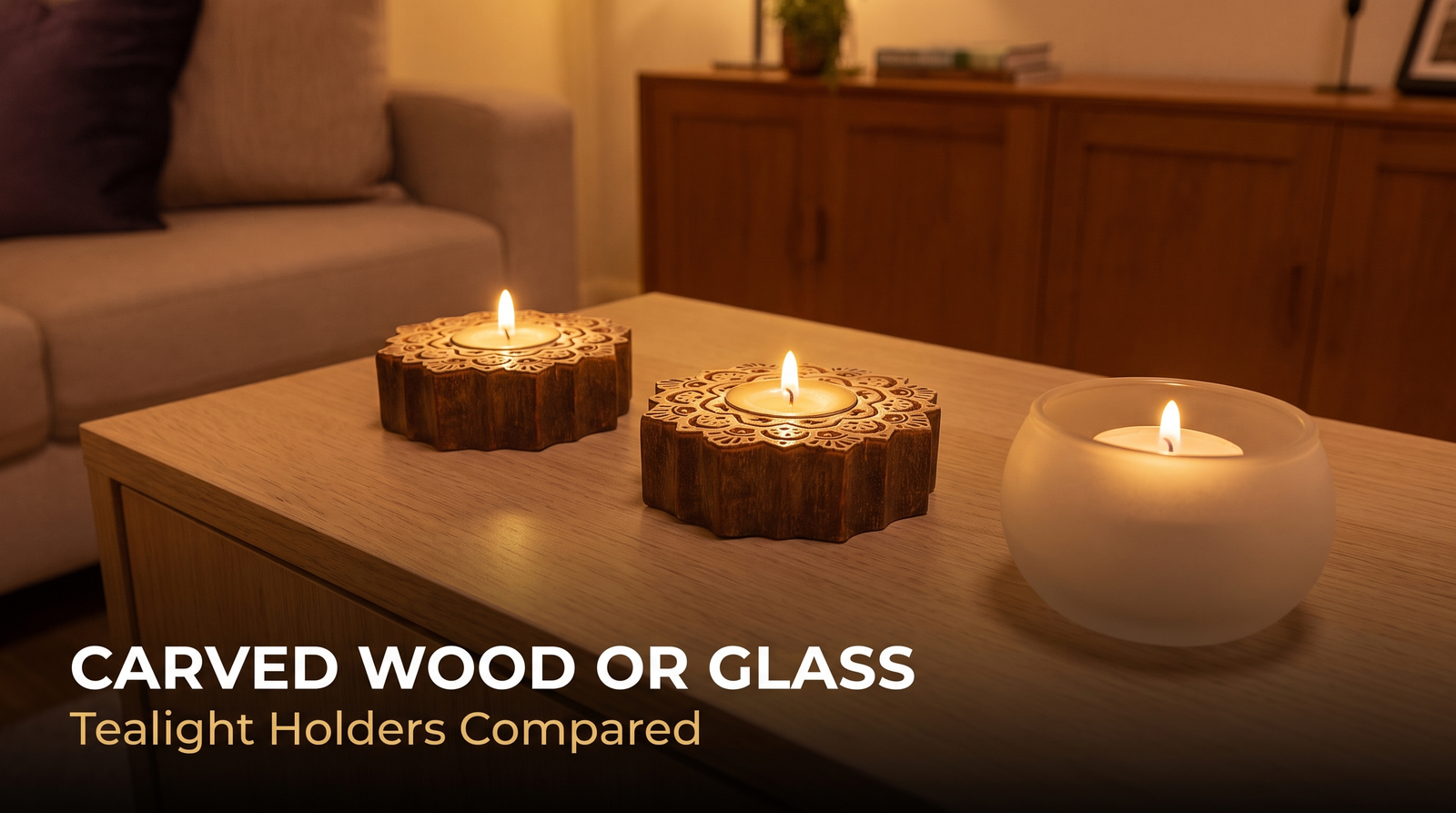
A tealight holder does one small job: it holds a candle safely and makes the room glow. Gleemium sells hand-carved solid wood holders. Koh Living sells glass holders designed by Aboriginal artists, and it also makes Australian soy tealights to put in them. We compared both on what they are made of, what a pair really costs, how safe they are, and how they are made. The surprise was that these two shops fit together better than they compete.
The short answer
For a natural, hand-carved holder that is better value when you buy a pair, choose Gleemium. A set of two carved mandala holders is $58 delivered, against $79.85 for two Koh Living holders once their shipping is added.
For the safest material, for supporting Aboriginal artists, or for buying a single holder, choose Koh Living. Glass does not burn, every design is credited to a named Aboriginal artist, and one holder costs $44.90 delivered.
And for candles, use Koh Living either way. Gleemium does not sell tealights. Koh Living's small soy tealights are made in Australia and fit a standard holder.
We checked both shops on 26 September 2026 from their own live product pages.
First, a surprise
Koh Living's "Tea Lights" page sells tealight candles, not holders. Gleemium's "Tea Lights" page sells holders, not candles. Same name, different product. So this comparison looks at the holders both shops sell — and then at why you might end up buying from both.
Meet the two shops
Gleemium
Hand-carved holders
Holders: 7, all in stock
Material: 5 in solid carved wood, 1 iron, 1 MDF
Price: $46 – $78
Sold as: sets of two (wooden range)
Shipping: free, no minimum
Made in: India, by artisans
Koh Living
Artist-designed glass holders
Holders: 21, all in stock
Material: glass with a layer of clay
Price: $24.45 – $36.95
Sold as: single holders, gift boxed
Shipping: $9.95, free over $99
Designed in: Australia, by Aboriginal artists
What this article covers
- A side-by-side look at the two holder ranges
- Why carved wood is the natural-material choice
- What a pair of holders really costs, delivered
- Safety first: wood, glass and an open flame
- The pairing we would actually buy, and the size that fits
- Where Koh Living genuinely does better
- Soy versus paraffin wax, without the hype
- Frequently asked questions
The holders, side by side
| What matters | Gleemium | Koh Living | Better for this |
|---|---|---|---|
| Material | Solid carved wood (5 of 7) | Glass with clay | Gleemium, if you want natural timber |
| How it is made | Hand-carved, every piece differs | Handmade with clay, gift boxed | Both handmade |
| Price for a pair, delivered | $58 – $78 | $79.85 | Gleemium |
| Price for one, delivered | No single carved holder | $34.40 – $46.90 | Koh Living |
| Safety of the material | Wood can burn | Glass cannot burn | Koh Living |
| Range | 7 holders | 21 holders | Koh Living |
| Who benefits | Artisan carvers in India | Named Aboriginal artists | Your values decide |
| Stock | All in stock | All in stock | Tie |
Checked 26 September 2026. Koh Living prices include its $9.95 shipping on orders under $99. Gleemium ships free with no minimum.
How we decided who comes first. This article looks at tealight holders through a natural-material lens, because that is what we set out to compare: solid timber, carved by hand, from a renewable source. On that lens Gleemium leads. But the table above is honest about the rest — Koh Living is safer by material, has three times the range, and directs part of every sale to Aboriginal artists. We would rather you see both than just our half.
Disclosure: Gleemium publishes this blog. Every figure comes from live product pages you can check yourself.
Why carved wood is the natural-material choice
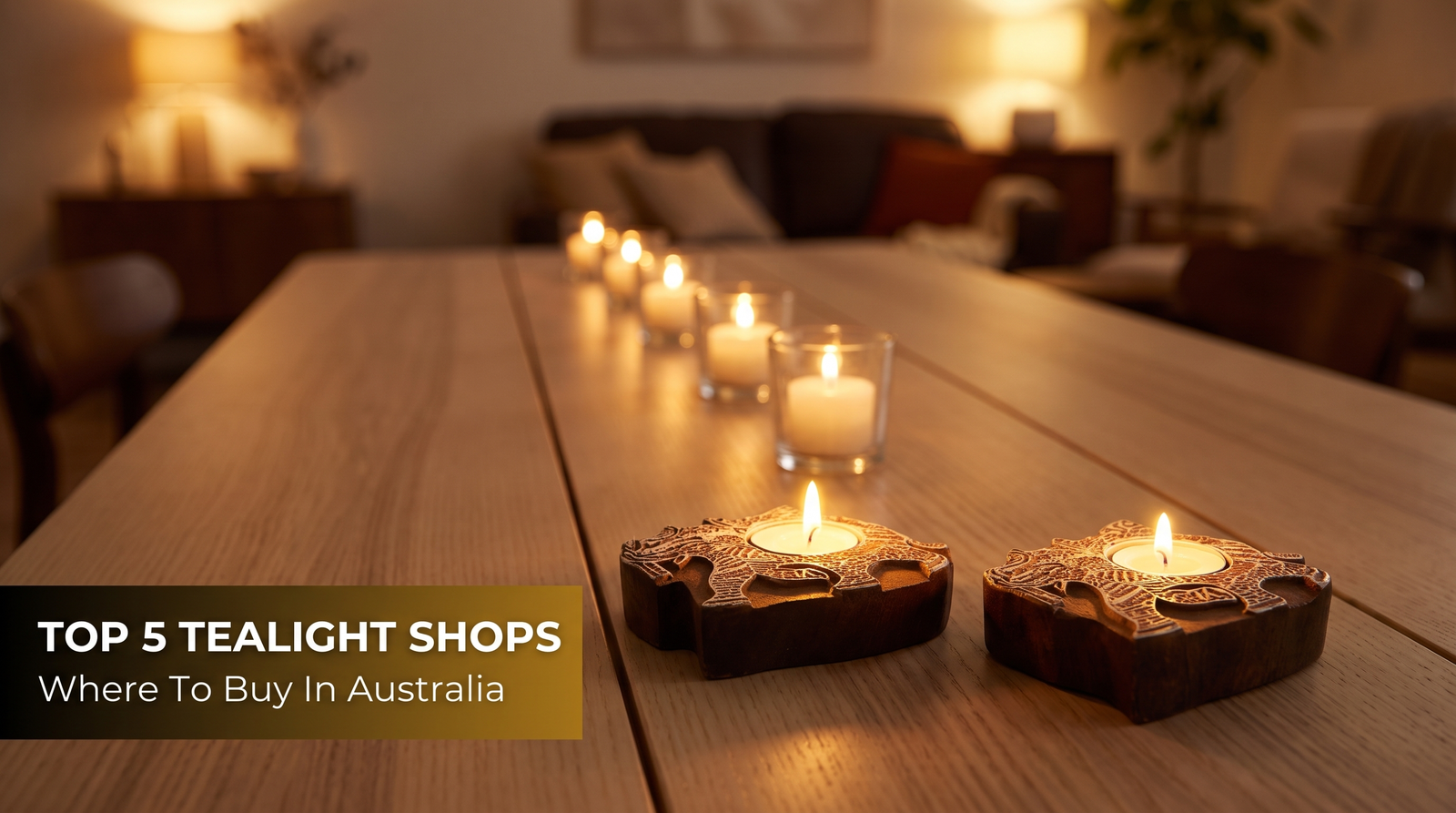
Five of Gleemium's seven holders are carved from solid wood, sold in pairs, in five designs: crescent moon, hamsa palm, mandala, elephant and lotus. Each set is carved by hand with traditional tools, so the grain and small details differ from one piece to the next. No two pairs match exactly.
Wood is a grown material. It comes from trees, it can be sanded and re-oiled if it gets marked, and at the end of its life it breaks down. Glass is made a different way. Its raw materials are melted in a furnace at around 1,500 to 1,700°C, and glass making is counted among the most energy-hungry manufacturing processes there is (International Journal of Applied Glass Science). Clay is fired in a kiln, which also takes a lot of heat.
The fair counterpoint: glass holders last for decades and glass can be recycled. A glass holder kept for twenty years spreads its footprint thinly. Grown is lighter to make; fired is not wasteful if you keep it.

What a pair really costs
Tealight holders usually live in pairs — either side of a mantel, down the middle of a table. Gleemium sells its wooden holders as sets of two. Koh Living sells them one at a time, with $9.95 shipping under $99.
| Two holders | Price | Shipping | Delivered |
|---|---|---|---|
| Gleemium carved mandala, set of 2 | $58.00 | Free | $58.00 |
| Gleemium carved crescent moon, set of 2 | $68.00 | Free | $68.00 |
| Gleemium carved lotus, elephant or hamsa, set of 2 | $78.00 | Free | $78.00 |
| Koh Living, two holders at $34.95 | $69.90 | $9.95 | $79.85 |
At every price point, a Gleemium pair lands cheaper at your door. The mandala set saves $21.85. Per holder, Gleemium's carved range works out at $29 to $39 each.
The fair caveat: if you only want one holder, Koh Living wins. A single holder is $44.90 delivered, and its cheapest design is $34.40. Gleemium does not sell a single carved wooden holder. And if you spend $99 or more at Koh Living, its shipping is free and the gap narrows.
Safety first: wood, glass and an open flame
Please read this if you buy a wooden holder
Wood can burn. Glass cannot. That is a real safety advantage for Koh Living, and we are not going to play it down.
A wooden holder is safe to use because the tealight sits inside its own aluminium cup, which holds the melted wax and keeps the flame away from the wood. Solid aluminium does not burn, and it does not melt until around 660°C (The Aluminum Association). The danger comes when that protection is lost.
- Always keep the tealight in its aluminium cup. Never pop a candle out of its cup and put it straight into wood.
- Never leave it burning when you leave the room, and always put it out before bed.
- Keep it clear of curtains, cushions and paper, and away from open windows and drafts.
- Use the right size. An oversized candle can sit higher and closer to the wood.
- Put it on a stable, heat-safe surface, out of reach of children and pets.
Fire and Rescue NSW says many of the house fires it attends each year are caused by unattended candles, and advises never leaving candles unattended and always putting them out before bed (Fire and Rescue NSW). That advice applies to every holder, glass included — but with wood it matters even more.

The pairing we would actually buy
Here is the honest answer that surprised us: the best set-up uses both shops. A carved Gleemium holder, with a Koh Living soy tealight inside it.
Koh Living's tealights are hand-poured in Australia from 100% soy wax. But not every one fits a standard holder, and this is the detail that matters:
| Koh Living tealight | Size | Burn time | Price | Fits a standard holder? |
|---|---|---|---|---|
| Soy unscented, small | 3.5cm wide, 2cm high | 5 – 6 hours | $2.50 | Yes |
| Soy unscented, large | 4.5cm wide, 4cm high | 14 – 16 hours | $4.50 | No, too wide |
| Native scented, large | 5cm wide, 4cm high | 14 – 16 hours | $5.95 | No, too wide |
Gleemium's holders are made for standard tealights. That means Koh Living's small unscented soy tealight is the one to pair with them. The large and scented ones are too wide, and a candle that does not sit down in the well is one that sits closer to the wood.
One honest cost to flag: ordering tealights on their own from Koh Living attracts their $9.95 shipping unless your order passes $99. Buy in bulk, or add them to a bigger order.

Where Koh Living genuinely does better
- Safety. Glass and clay do not burn. If you have young children, pets, or you are likely to forget a candle, that matters more than anything else in this article.
- Supporting Aboriginal artists. Every one of Koh Living's 21 holders is credited to a named Aboriginal artist, and Koh Living states that a portion of each sale goes to the artist. Each holder comes gift boxed with a story card about the design.
- Range. Twenty-one designs against our seven.
- A single holder. If you only need one, Koh Living is cheaper and we cannot offer a single carved piece.
- They make the candles. Hand-poured soy tealights, made in Australia. We do not sell tealights at all.
Two Gleemium holders that do not fit our argument
Our heart accent tealight holder at $46 is made from MDF, not solid wood. MDF is an engineered board made from wood fibres bound with resin, and it cannot be sanded back the way solid timber can. Our silver reindeer holder at $54 is iron — sturdy and non-combustible, but not timber. If you are buying on the natural-material argument above, those two are the holders in our range it does not apply to. Choose one of the five carved sets instead.
Soy versus paraffin, without the hype
Koh Living's tealights are soy. Most cheap tealights are paraffin. Here is what actually differs, according to a candle maker that set out to check the research rather than repeat claims (The Victorian Candle Co.).
- Where it comes from. Soy wax is made from soybean oil, a renewable crop. Paraffin is a by-product of petroleum refining. That difference is real.
- Soot. Soy tends to produce less soot when burned well — but wick care matters a lot. An untrimmed soy candle can smoke more than a well-kept paraffin one.
- Burn time. Soy generally burns more slowly than paraffin at the same weight, often lasting noticeably longer.
- The health question. Studies have found paraffin can release chemicals such as toluene and benzene when burned. But for occasional use in a well-aired room, the difference is unlikely to be significant. Be wary of anyone who claims more than that.
- Soy is not perfect either. Most commercial soy wax is a blend, and soy farming has been linked to land clearing in some regions. Where it is grown matters.

Looking after your holders
| Carved wood (Gleemium) | Glass and clay (Koh Living) | |
|---|---|---|
| Cleaning | Wipe with a dry cloth | Wipe with a damp cloth |
| Wax spills | Let it harden, then lift it off gently. Do not scrape the carving | Let it harden and lift off, or warm gently |
| Avoid | Soaking, and wax overflowing onto the wood | Knocks and sudden temperature changes |
| If it gets marked | Sand lightly and re-oil | Clean it; chips cannot be repaired |
So which should you buy?
- You want natural, hand-carved timber. Gleemium.
- You want a pair for the mantel or table. Gleemium — cheaper delivered at every price.
- You want just one holder. Koh Living.
- You have small children or pets, or you tend to forget candles. Koh Living. Glass is the safer material.
- You want to support Aboriginal artists. Koh Living.
- You need tealights to go in them. Koh Living's small soy tealights, whichever holder you choose.
- It is a gift. Both work well. Gleemium for carved, one-of-a-kind timber; Koh Living for a gift box with a story card.
Frequently asked questions
Is Gleemium or Koh Living better for tealight holders?
Gleemium is the choice for natural, hand-carved solid wood holders, and a pair is cheaper delivered — from $58 against $79.85. Koh Living is the choice for safety, for supporting Aboriginal artists, for a wider range, and for buying a single holder. Many people will do best buying Gleemium holders and Koh Living's soy tealights.
Are wooden tealight holders safe?
Yes, when used correctly. The tealight must stay in its aluminium cup, which holds the wax and flame away from the wood. Never leave a candle burning unattended, keep it clear of curtains and fabric, and put it out before you leave the room. Glass holders are safer by material because glass cannot burn.
Does Koh Living sell tealight candles or holders?
Both. Its "Tea Lights" page sells hand-poured soy tealight candles made in Australia, from $2.50. It also sells 21 glass tealight holders, each designed by a named Aboriginal artist, from $24.45.
Will Koh Living's tealights fit a Gleemium holder?
The small unscented soy tealight will — it is 3.5cm wide, a standard size. The large unscented and the scented tealights are 4.5 to 5cm wide and will not fit a standard holder.
How much do tealight holders cost in Australia?
At these two shops on 26 September 2026, Gleemium's holders were $46 to $78 with free shipping, and its carved wooden sets of two worked out at $29 to $39 per holder. Koh Living's were $24.45 to $36.95 each, plus $9.95 shipping under $99.
Do Koh Living holders support Aboriginal artists?
Each of Koh Living's holders is credited to a named Aboriginal artist, and the company states that a portion of each sale goes to the artist. The holders are designed in Australia and come gift boxed with a story card.
Are soy tealights better than paraffin?
Soy wax comes from a renewable crop, while paraffin comes from petroleum. Soy tends to produce less soot and burn longer when the wick is looked after. Paraffin can release chemicals such as toluene and benzene, but for occasional use in a well-aired room the difference is unlikely to be significant.
Are Gleemium tealight holders made in Australia?
No. Gleemium's holders are carved by artisans in India. Koh Living's holders are designed in Australia, and its tealights are made in Australia.
Sources
- Gleemium — Tealight holders collection, 7 listings checked 26 September 2026
- Koh Living — Tea Lights collection and tealight candle holder product pages, checked 26 September 2026
- Koh Living — site-wide shipping banner ($9.95 flat, free over $99), 26 September 2026. Its written shipping policy page still lists older rates, so check at checkout.
- Fire and Rescue NSW — Candle safety
- The Aluminum Association — Fire safety of aluminum and its alloys
- International Journal of Applied Glass Science — Energy-efficient combustion technologies for glass melting furnaces (2026)
- The Victorian Candle Co. — Soy wax vs paraffin: what the research actually says
Prices, stock and shipping were checked on 26 September 2026 and will change. Confirm on each shop's own site before you buy. Gleemium publishes this blog and leads this comparison on a natural-material lens; we have stated plainly that glass is the safer material, that Koh Living supports Aboriginal artists and has three times our range, and that two holders in our own range are not solid wood.