

Quick answer
Ecology Homewares and Gleemium are not really rivals — they sell different materials for different jobs. Ecology designs ceramic, porcelain and stoneware serveware in Australia, so its pieces go in the dishwasher and hold up to hot food. Gleemium sells handmade wooden platters and trays in mango, acacia, teak and rosewood, priced $38 to $120, which look warmer on a grazing table but must be hand washed. Pick ceramic if you want low effort and hot food. Pick wood if you want texture, warmth and a piece that can be sanded and re-oiled instead of thrown out. Plenty of Australian homes end up owning both.
Key takeaways
- The real choice is material, not brand. Ecology's serveware is porcelain, ceramic, china and stoneware (Ecology Homewares). Gleemium's platter range is almost entirely timber — of 52 pieces, 28 mention mango wood, 6 acacia, 4 teak and 4 rosewood.
- Ecology does not publish prices on its serveware category page. Every product on the serving platters page is listed as "P.O.A." — price on application. You need to register or log in, or buy through a stockist. Gleemium prices are visible on every product.
- Gleemium's platter range runs $38 to $120, with a median of $50. 49 of 52 pieces were in stock when this was written.
- Shipping works differently. Ecology offers free shipping once you spend $120. Gleemium ships free to any Australian address with no minimum spend.
- Grazing-style serving is now mainstream. 44% of Australian couples now choose grazing tables, feasting platters or similar over traditional alternate-drop catering (Ever After Weddings).
- Both are Australian-owned. Ecology was founded in Victoria in 2008. Gleemium ships from Perth.
This article covers
- Who is Ecology Homewares?
- Who is Gleemium?
- Side-by-side comparison
- Which material should you pick — ceramic or wood?
- Can you put a serving platter in the dishwasher?
- What size platter do you need for a grazing table?
- How do you look after each type?
- Which one should you buy?
- Frequently asked questions
- Sources
Who is Ecology Homewares?

Ecology is an Australian homewares brand founded in Victoria in 2008, making ceramic and stoneware tableware designed in Australia and produced by offshore manufacturers. Its serveware range covers platters, footed plates, dip bowls and serving bowls in collections with names like Ottawa, Cecile, Rhodes and Oyster.
What stands out:
- Pieces are made from porcelain, ceramic, china or stoneware (Ecology Homewares)
- Designed in Australia, with earthy tones, organic shapes and hand-drawn patterns
- Large, coordinated collections — you can match a platter to dip bowls and dinnerware
- Free shipping once you spend $120
- Widely stocked in Australian department stores and gift shops
One thing to know before you shop. On the serving platters category page, every item is shown as "P.O.A." rather than a price. You will need to register an account, log in, or find the piece at a stockist to know what it costs. That is not unusual for a brand that sells heavily through retailers, but it does make quick price comparison harder.
Who is Gleemium?

Gleemium is an Australian homewares store selling handmade wooden platters, boards and trays, shipped free from Perth. The platter range holds 52 pieces priced between $38 and $120, with a median price of $50.
What stands out:
- Almost all timber — mango wood, acacia, teak and rosewood
- Hand cut, hand carved, hand painted or enamelled, so no two pieces match exactly
- Decorative finishes you don't often see in ceramic: mother of pearl inlay, painted florals, abstract carving
- Free postage to every Australian address, with no minimum spend
- Prices shown openly on every product page
Good starting points are the Acacia Serving Board ($75) for cheese and charcuterie, the Abstract Mango Wood Platter ($43) as an affordable first piece, and the Wooden Serving Trays Set ($120) if you entertain often. The full range is in Platters & Trays.
One thing to know. Wood cannot go in the dishwasher, and it needs oiling a few times a year. If nobody in your house will do that, ceramic is the more honest choice.
Full disclosure: this guide is published by Gleemium. We have tried to describe Ecology fairly using their own published information, and to be clear about where wood is the weaker option.
Side-by-side comparison
| Ecology Homewares | Gleemium | |
|---|---|---|
| Main materials | Porcelain, ceramic, china, stoneware | Mango wood, acacia, teak, rosewood |
| Founded / based | 2008, Victoria | Ships from Perth |
| Range on platters page | 12 pieces listed | 52 pieces |
| Prices shown online | No — "P.O.A." | Yes, on every product |
| Price range | Not published | $38 – $120 (median $50) |
| Dishwasher safe | Generally yes | No — hand wash |
| Microwave / oven | Usually safe | No |
| Hot food | Yes | Warm, not hot |
| If you drop it | Can chip or shatter | Usually survives |
| Repairable | No | Yes — sand and re-oil |
| Free shipping | Over $120 | Every order, no minimum |
| Sold through shops | Yes, many stockists | Online only |
Information gathered from both companies' public websites in September 2026. Ecology does not publish prices on the serveware category page, so no price range is shown. Check both sites for current details.
Which material should you pick — ceramic or wood?
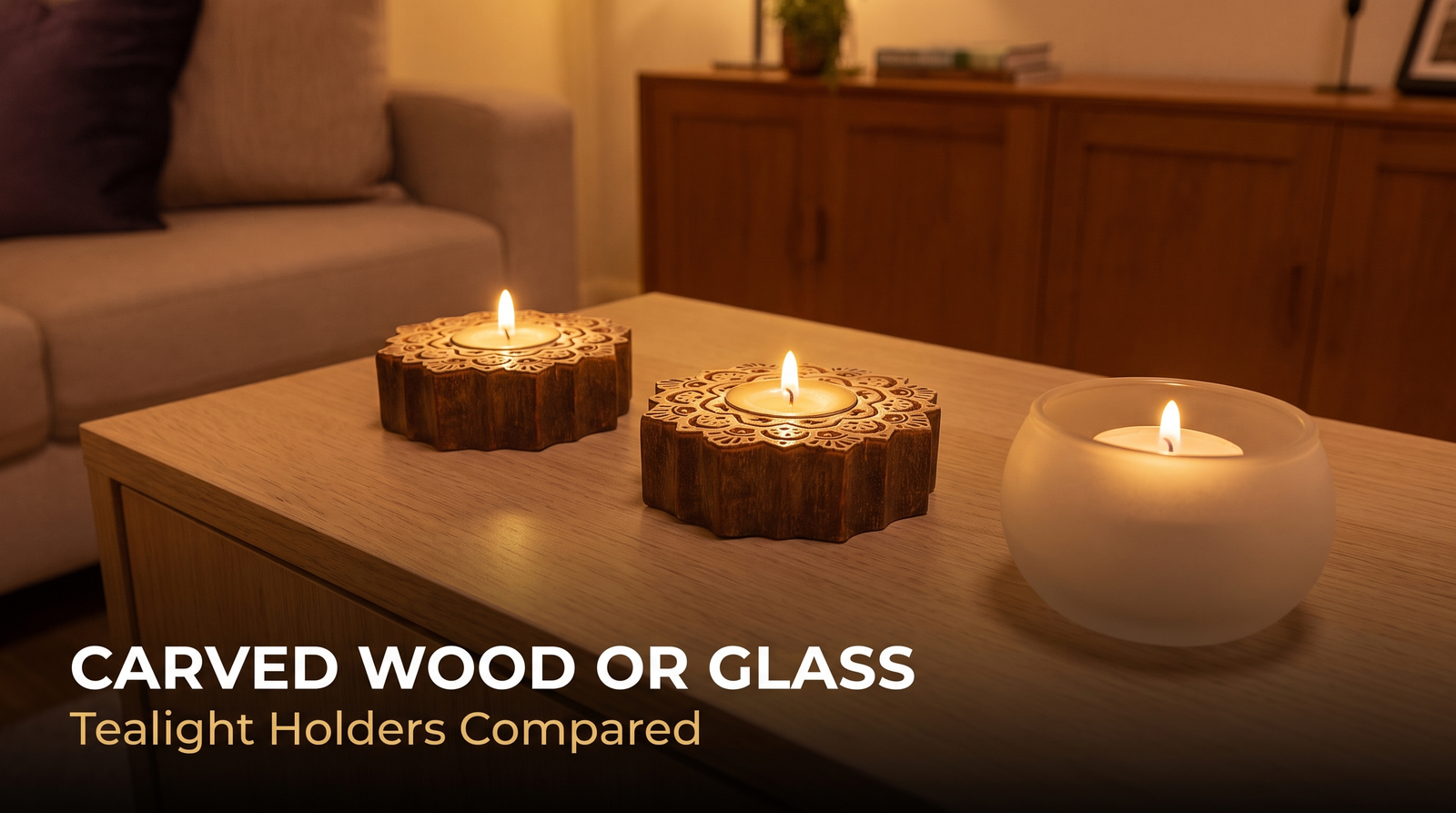
Choose ceramic or stoneware if you want something you can put in the dishwasher and use for hot food. Choose wood if you want warmth, texture and a piece you can repair. Neither is better overall — they fail in different ways.
Ceramic, porcelain and stoneware
These are clay bodies fired at very high heat until they turn glassy and stop absorbing water. Porcelain is fired hottest, roughly 1,300 to 1,350°C, while stoneware sits a little lower at about 1,150 to 1,260°C (Joyye).
That firing is why the glazed surface wipes clean and goes in the dishwasher. Stoneware is thicker and takes knocks better; porcelain is harder and copes better with sudden temperature changes (Malacasa).
Best for: everyday use, hot dishes, households that will not hand wash.
Watch out for: weight, and the fact that a dropped piece is usually finished.
Wood
Wood is lighter, warmer to look at, and will not shatter on a tiled floor. It is also the only option on this page you can repair — a scratched board can be sanded back and re-oiled.
On hygiene, wood does better than people expect. Research at UC Davis found bacteria placed on wooden surfaces were pulled down into the fibres and mostly died there, while bacteria on knife-scarred plastic survived washing (Cliver, UC Davis). That is a lab result about materials rather than a promise about any single board, and the practical rule still stands: wash it, dry it, don't leave it wet.
Mango wood is also a sensible pick on sustainability grounds. It is a by-product of fruit farming — orchard trees are milled for timber once they stop producing well, rather than being cut down purely for wood (Homescapes).
Best for: grazing boards, cheese, bread, fruit, dry snacks, anything you want to look generous.
Watch out for: no dishwasher, no hot food straight from the oven, and it needs oiling.
Can you put a serving platter in the dishwasher?
Ceramic, porcelain and stoneware platters are almost always dishwasher safe. Wooden platters are not. Check the base of any ceramic piece for a dishwasher symbol, since hand-painted or metallic-trimmed designs are sometimes excluded.
For wood, the dishwasher is the quickest way to ruin a board. The long soak swells the timber and the drying cycle shrinks it unevenly, which causes warping and splitting. Wash wooden pieces by hand in warm soapy water, then stand them on edge to dry so both faces dry at the same rate.
What size platter do you need for a grazing table?

As a rough guide, allow one large platter of about 40cm for every four to six guests, or one medium 30cm platter for every two to three. Grazing works better with several medium platters spread along the table than one enormous one, because people can reach without leaning across each other.
| Guests | Setup that usually works |
|---|---|
| 2–3 | One 30cm platter or board |
| 4–6 | One 40cm platter, or two 30cm |
| 8–10 | Two to three platters plus small bowls for olives and dips |
| 12+ | A run of boards down the centre of the table, mixed sizes |
Mixing shapes and heights is what makes a grazing table look full. A long board, a round platter and a couple of raised or footed pieces read as more generous than the same food on one flat tray.
How do you look after each type?

Ceramic and stoneware
Dishwasher is fine. Avoid sudden temperature changes — do not move a dish straight from the fridge into a hot oven, since that can crack the glaze. Stack with a cloth or felt pad between pieces to stop the bases scratching the glaze underneath.
Wood
Wash by hand in warm water with a little mild detergent, straight after use. Never soak it. Dry it standing on edge rather than flat, so one face does not stay damp.
Oil it with food-grade mineral oil every month or two, or whenever the timber looks pale and dry. Apply a generous coat, leave it a few hours or overnight, then wipe off whatever has not soaked in.
Never use olive oil or other cooking oils — they go rancid in the timber and the board develops a stale smell you cannot wash out.
The quick test: flick a few drops of water onto the surface. If they bead up, the board is sealed. If they soak straight in, it needs oiling.
For stains or garlic smells, scrub with coarse salt and half a lemon, then rinse and dry.
Which one should you buy?
Buy Ecology if you want matching sets, you serve hot food on your platters, you would rather use the dishwasher, or you like to see and handle a piece in a shop before buying.
Buy Gleemium if you want handmade timber with visible grain and carving, you are building a grazing or cheese setup, you want prices shown up front, or you would rather not hit a $120 minimum to get free shipping.
Buy both if you entertain regularly. This is what most people actually end up doing. Ceramic bowls hold dips, olives and anything wet; wooden boards carry the cheese, bread, cured meats and fruit. They look good together, and each is doing the job it is best at.
Frequently asked questions
Is Ecology Homewares an Australian brand?
Yes. Ecology was founded in 2008 and is based in Victoria. Its pieces are designed in Australia and made by its manufacturers from porcelain, ceramic, china or stoneware.
Why does Ecology not show prices on its website?
On the serving platters category page, products are listed as "P.O.A." — price on application. You need to register or log in to see pricing, or buy through one of their stockists. This is common for brands that sell mainly through retail partners.
How much do wooden serving platters cost in Australia?
Small wooden platters start around $35 to $50. Mid-size boards run $50 to $80. Large boards, sets and decorative inlaid pieces usually sit between $80 and $150. Gleemium's range runs $38 to $120, with a median of $50.
Are wooden serving platters hygienic?
Yes, when looked after. Research on wooden surfaces found bacteria were drawn into the fibres and mostly died there, while bacteria on scratched plastic survived washing. Hand wash, dry straight away, and do not let the board sit wet.
Can you serve hot food on a wooden platter?
Warm food is fine. Avoid anything straight from the oven or a hot pan, since sustained heat dries the timber out and can cause splitting. Use ceramic or stoneware for hot dishes.
What is the difference between stoneware and porcelain?
Both are clay fired until non-porous. Porcelain is fired hotter, around 1,300 to 1,350°C, making it harder, thinner and better with temperature changes. Stoneware is fired a little cooler and made thicker, so it handles knocks better but is slightly more sensitive to thermal shock.
Do wooden platters need to be oiled?
Yes, every month or two with regular use. Use food-grade mineral oil, never cooking oils like olive or canola, which turn rancid in the wood.
Which is better for a grazing platter — wood or ceramic?
Wood, for most of it. Cheese, bread, crackers, cured meats and fruit look better on timber and it is lighter to carry when loaded. Use small ceramic bowls alongside for dips, olives and anything oily or wet.
Sources
- Ecology Homewares — Our Story (brand founding, Victoria base, materials) — ecologyhomewares.com.au
- Ecology Homewares — Serving Platters, Boards & Bowls (product range, P.O.A. pricing, $120 free shipping threshold) — ecologyhomewares.com.au
- Gleemium — Platters & Trays collection (52 products, pricing, materials, accessed September 2026) — gleemium.com
- Ever After Weddings — Wedding Statistics Australia (44% choosing grazing tables and feasting platters) — everafterweddings.com.au
- Cliver, D.O., UC Davis Food Safety Laboratory — Plastic and Wooden Cutting Boards — naturalhandyman.com
- Joyye — Porcelain vs Stoneware (firing temperatures) — joyye.com
- Malacasa — Porcelain Dinnerware vs Stoneware (chip resistance, thermal shock) — malacasa.com
- Homescapes — How Sustainable is Mango Wood? — homescapesonline.com
Last reviewed: 19 September 2026. Product counts and prices were checked on both websites in September 2026 and will change over time.
Building a grazing setup? Browse Gleemium's handmade serving platters and wooden trays — hand cut timber, prices shown up front, and free postage anywhere in Australia.