

QUICK ANSWER
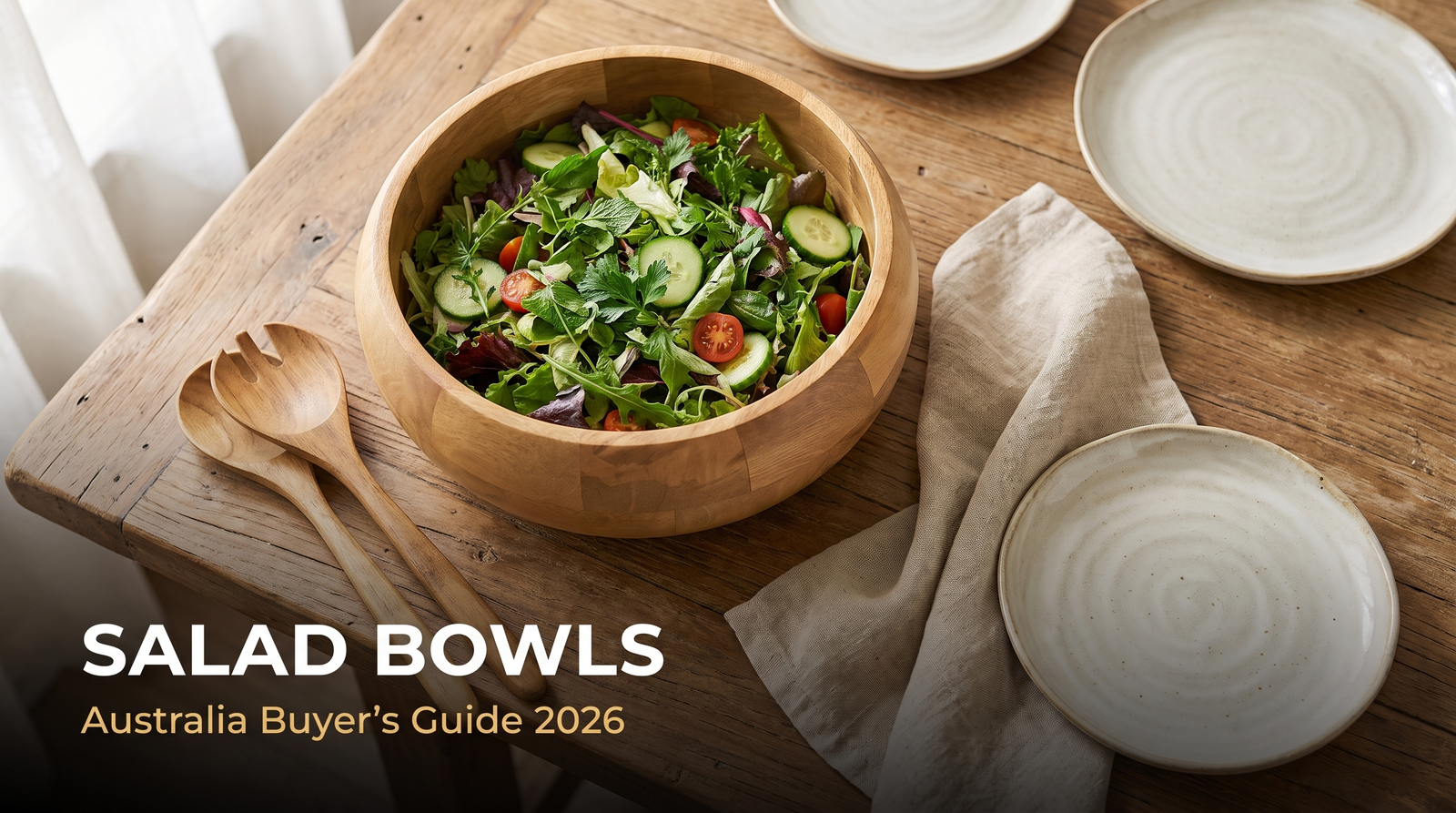
The best salad bowl shops in Australia are Gleemium for handmade wooden bowls, MIJ for Japanese ceramic bowls, Pottery For The Planet for handmade Australian ceramics, salt&pepper for modern white serveware, and Kmart for budget buys. Wooden bowls suit dressed salads and last for decades with oiling. Ceramic suits everyday use and goes in the dishwasher. Expect to pay $10–$30 at the budget end and $57–$127 for handmade.
Key takeaways
- Material decides everything. Wood is warm and gentle on greens but needs hand washing. Ceramic is low-effort and dishwasher safe but heavier and breakable.
- Wood is not less hygienic. Landmark UC Davis research found bacteria placed on wooden surfaces were drawn into the fibres and died there, while bacteria on scratched plastic survived washing (Cliver, UC Davis).
- Size matters more than people expect. A 25–30cm bowl serves 4–6 people. Under 20cm is a single serve.
- Mango and acacia are sustainable choices. Mango timber is a by-product of fruit farming — trees are milled once fruiting slows (Homescapes).
- Never soak a wooden bowl. Wash by hand, dry immediately, and oil it a few times a year.
This article covers
- Top 5 salad bowl shops in Australia (ranked)
- Quick comparison table
- How we ranked these shops
- Wood vs ceramic vs stainless steel
- What size salad bowl do you need?
- How to care for a salad bowl
- Frequently asked questions
- Sources
Top 5 salad bowl shops in Australia (ranked)
1. Gleemium — best for handmade wooden salad bowls

Gleemium leads for anyone who wants a bowl made by hand rather than pressed out of a mould. The bowls are turned one at a time from mango wood and acacia, so the grain pattern on each one is different.
What stands out:
- Hand-turned mango wood and acacia, with plain and hand-enamelled finishes
- Sets that include matching wooden servers
- Nesting sets of two for smaller kitchens
- Prices from $57 to $127
Mango wood is a genuinely sensible pick. The timber is a by-product of mango fruit farming — orchard trees are milled for timber once they stop producing well, rather than being felled purely for wood (Homescapes). It is also a real hardwood, sitting around 1,070 lbf on the Janka hardness scale, which is close to teak (The Wood Carpenter).
Start with the Minimalist Salad Bowl ($79) or the Mango Wood Salad Bowl ($89). The full range sits in the serving bowls collection.
2. MIJ (Made In Japan) — best for Japanese ceramic bowls

MIJ imports handcrafted tableware directly from Japan. Bowls are made by artisans in the Mino region using glazing methods refined over centuries, so no two pieces are identical (MIJ).
What stands out:
- Most salad bowls run 15–24cm, with 28cm options for a crowd
- Microwave and dishwasher safe
- Distinct glazes and textures you will not see elsewhere
- Strong for grain bowls and side dishes, not just salad
Pick this if you want ceramic with real character and do not want to hand wash.
3. Pottery For The Planet — best for handmade Australian ceramic

Pottery For The Planet designs in Australia and its salad bowls are handmade, so each is one of a kind with natural variation in glaze and size.
What stands out:
- Wide, shallow shape that shows the salad off instead of burying it
- Dishwasher and microwave safe, and rated for commercial use
- Designed in Australia
- Sustainability built into the brand
A good middle ground: handmade feel, but tough enough for real life.
4. salt&pepper — best for modern white serveware

salt&pepper is an established Australian homewares brand. Its serving bowls are made from glass, porcelain and stoneware, in large family-style sizes and smaller individual ones.
What stands out:
- Clean white and neutral pieces that match most dinner sets
- Dishwasher and microwave safe
- Matching collections if you want plates and bowls to line up
- Widely stocked, with regular sales
Best when you want the bowl to blend into an existing table rather than stand out.
5. Kmart — best for budget

Kmart is the obvious pick when price comes first. Plenty of bowls sit in the $10–$25 range.
What stands out:
- Lowest prices of any shop on this list
- Simple shapes in bamboo, melamine and ceramic
- Easy to grab in store
- Fine for picnics, kids and outdoor meals
The finish is basic and bamboo pieces will not last like solid hardwood, but for the money it does the job.
Also worth a look: Wheel & Barrow has stocked kitchenware for over 30 years and has stores in most capital cities, which helps if you want to handle a bowl before buying.
Quick comparison table
| Shop | Best for | Main material | Typical price | Dishwasher safe |
|---|---|---|---|---|
| Gleemium | Handmade wooden bowls | Mango wood, acacia | $57–$127 | No — hand wash |
| MIJ | Japanese ceramic | Mino ceramic, stoneware | $40–$120 | Yes |
| Pottery For The Planet | Handmade Australian ceramic | Stoneware | $70–$150 | Yes |
| salt&pepper | Modern white serveware | Porcelain, stoneware, glass | $30–$90 | Yes |
| Kmart | Budget | Bamboo, melamine, ceramic | $10–$25 | Varies |
Prices are indicative ranges for salad and serving bowls at the time of writing, not fixed quotes. Check each site for current pricing.
How we ranked these shops
We scored each shop on four things:
- Craft — is the bowl genuinely made by hand, or mass-produced?
- Material quality — will it last, and is the timber or clay food-safe?
- Value — is the price fair for the work and materials?
- Availability — can you actually get it delivered anywhere in Australia?
Gleemium ranked first because the bowls are hand-turned from solid hardwood at prices that overlap with mass-made ceramic. MIJ and Pottery For The Planet ranked next on genuine craft. salt&pepper and Kmart score on convenience and price rather than craft.
Wood vs ceramic vs stainless steel
Wooden salad bowls
Wood is warm, light and does not bruise delicate leaves the way metal can. It is also the best-looking option on a table.
The common worry is hygiene, and the research does not support it. Dean Cliver's team at UC Davis compared wooden and plastic surfaces and found that bacteria placed on wood were drawn down into the fibres, away from the surface, where the large majority died within minutes to hours. On plastic, bacteria stayed put — and once the plastic was knife-scarred, they survived hot water and detergent (Cliver, UC Davis).
That study looked at cutting boards rather than bowls, so treat it as evidence about wood as a material, not a food-safety guarantee for any particular bowl. The practical rule still applies: wash by hand and dry it straight away.
Best for: dressed salads, everyday serving, tables where the bowl is part of the look.
Watch out for: no dishwasher, no soaking, needs oiling.
Ceramic and stoneware bowls
Ceramic is glazed, so it is non-porous and wipes clean. It goes in the dishwasher and usually the microwave.
Best for: low-effort everyday use, hot and cold food, households that want to stack and forget.
Watch out for: heavy, and it chips or breaks if dropped.
Stainless steel bowls
Steel is nearly indestructible and stays cold, which is handy for prepping ahead.
Best for: mixing, prepping, transporting to a picnic.
Watch out for: it looks utilitarian on a table, and acidic dressings left sitting in cheap steel can pick up a metallic taste. Store leftovers in glass or ceramic instead.
What size salad bowl do you need?
Measure across the top, rim to rim.
| Diameter | Serves | Best use |
|---|---|---|
| Under 20cm | 1 | Individual portion, side salad |
| 20–25cm | 2–3 | Couple or small family side |
| 25–30cm | 4–6 | Family dinner, the usual sweet spot |
| 30cm+ | 6–10 | Entertaining, barbecues, big share bowls |
Most households are best served by a bowl in the 25–30cm range. A deeper bowl helps when you are tossing dressing through, since shallow bowls throw leaves over the side.
How to care for a salad bowl
Wooden bowls. Wash by hand in warm water with a little mild detergent. Never soak it and never put it in the dishwasher — trapped water swells the timber and causes cracking. Dry it immediately with a tea towel. Every few months, rub in a food-safe oil such as food-grade mineral oil, let it sit overnight, then buff off the excess. Done properly, a hardwood bowl outlives most kitchens.
Ceramic bowls. Dishwasher is fine. Avoid sudden temperature changes, like moving a bowl straight from the fridge into a hot oven, which can crack the glaze.
Stainless steel. Dishwasher safe. Do not leave acidic dressings sitting in it for long periods.
Frequently asked questions
Are salad bowls healthy?
The bowl itself does not change the nutrition of your food. What matters is the material being food-safe and properly finished — a sealed glaze on ceramic, or a food-safe oil on timber. Any of the bowls on this list are fine for daily use.
Are salad bowls safe?
Yes, when they are made for food use and looked after. Wooden bowls should be finished with a food-safe oil and washed by hand. Ceramic bowls should have an intact glaze — replace one that is badly chipped or crazed, since damaged glaze is harder to clean.
Are wooden salad bowls hygienic?
Research on wooden surfaces found bacteria are drawn into the wood fibres and mostly die there, while bacteria on scratched plastic survived washing (Cliver, UC Davis). Wash by hand, dry straight away, and do not let it sit wet.
Can you store salad in a stainless steel bowl?
For a few hours, yes. For longer storage, move it to glass or ceramic with a lid. Acidic dressings sitting in lower-grade steel for a long time can pick up a metallic edge.
What size salad bowl serves 4 people?
A bowl between 25cm and 30cm across serves roughly 4 to 6 people as a side. Go 30cm or larger if the salad is the main dish.
Can wooden salad bowls go in the dishwasher?
No. The heat and long soak swell and then dry the timber unevenly, which causes splitting. Hand wash and dry immediately.
How much does a salad bowl cost in Australia?
Budget bowls start around $10 to $25. Mid-range ceramic runs $30 to $90. Handmade wooden and artisan ceramic bowls usually sit between $57 and $150, depending on size and the work involved.
Sources
- Cliver, D.O., UC Davis Food Safety Laboratory — Plastic and Wooden Cutting Boards — naturalhandyman.com
- MIJ (Made In Japan) — Salad Bowls collection — mij.com.au
- Pottery For The Planet — Salad Bowls — potteryfortheplanet.com
- salt&pepper — Salad Bowls collection — saltandpepper.com.au
- Kmart Australia — Serving & Salad Bowls — kmart.com.au
- Wheel & Barrow — Salad & Serving Bowls — wheelandbarrow.com.au
- Homescapes — How Sustainable is Mango Wood? — homescapesonline.com
- The Wood Carpenter — Mango Wood: Properties, Pros, Cons & Uses — thewoodcarpenter.com
Last reviewed: 11 September 2026.
Looking for a bowl that lasts? Browse Gleemium's hand-turned wooden salad bowls — each one turned by hand, with grain no other bowl has.