

Summary
A cake stand is not something you replace every year. It comes out for birthdays, Christmas and the occasional Sunday, and then it lives in a cupboard for months. So the question is not which one is cheapest today — it is which one you will still be using in 2040. We put both ranges through seven rounds and scored each one on the numbers. One surprise: once delivery is counted, the price difference almost vanishes.
The verdict
Gleemium wins this comparison four rounds to three, because a cake stand is a keep-forever object and wood and marble outlast glazed ceramic when things go wrong. Salt & Pepper wins on availability, on being dishwasher safe, and it has the single cheapest stand at $59.99.
But here is the part nobody mentions: Salt & Pepper charges $11.95 delivery under $99 and Gleemium ships free. Add that in and at matching sizes Gleemium is the cheaper one.
We checked both ranges on 26 September 2026 from their own live product pages.
The scorecard
Final score: Gleemium 4 — Salt & Pepper 3. Read on for why, and for the rounds where you might reasonably disagree with us.
What this article covers
- How we scored it, and how the rounds are weighted
- Seven head-to-head rounds with the numbers behind each
- The delivered-price table nobody publishes
- Where Salt & Pepper genuinely beats us
- Inches versus centimetres, and how to size a stand to your cake
- How to look after each material
- Frequently asked questions
How we scored it
We opened both collections and recorded every stand: price, size, material, stock status and country of manufacture. Then we set the rounds.
The weighting, stated up front: this comparison treats a cake stand as an object you keep, not one you use up. That means materials and lifespan carry more weight than the sticker price. If you disagree — if you want something cheap and cheerful for one party — then Salt & Pepper wins and you should skip to Round 3.
Disclosure: Gleemium publishes this blog and wins this comparison. Every figure below comes from live product pages you can check yourself, the three rounds Salt & Pepper wins are reported in full, and there is a whole section on where they beat us.
Round 1 · Materials
Gleemium: 9 of 10 stands in wood, marble or a wood-and-stone mix · Salt & Pepper: 2 stoneware, 1 glass
This is the clearest gap in the whole comparison.
Gleemium's ten stands are built from acacia (6 of them), mango wood (3), white marble (4) and iron bases (2), often combining two. One outlier is hand-poured resin, and we will come back to that because it does not fit the story. All ten are described as hand cut by artisans using chisels, saws and lathes.
Salt & Pepper's three are Riley in high-fired stoneware with a sheer glaze, Leif in stoneware with a matte glaze, and Quinn in clear ribbed glass. None is described as handmade.
Why it matters beyond the label. Acacia and mango are grown, not fired. Mango in particular comes from trees planted for fruit and milled once their yield drops, so the timber is a by-product of an existing harvest rather than the reason the tree was cut. Marble is quarried and essentially inert. Stoneware, by contrast, is fired at roughly 1,100 to 1,300°C, and firing is the dominant impact in ceramic manufacture — one lifecycle study of tableware production found manufacturing accounted for about 73 to 77% of each piece's greenhouse gas emissions, with firing fuel making up the overwhelming share of that (Journal of Design Research).
Honest counterpoint: that same body of research makes the point that a long-lived ceramic piece spreads its footprint across decades of use, so a stoneware stand you keep for twenty years is not a bad object. Fired does not mean wasteful. It means the impact is paid up front.
Round 1 to Gleemium — grown and quarried materials, and nine of ten stands qualify.

Round 2 · Choice
Gleemium: 10 stands · Salt & Pepper: 3 stands
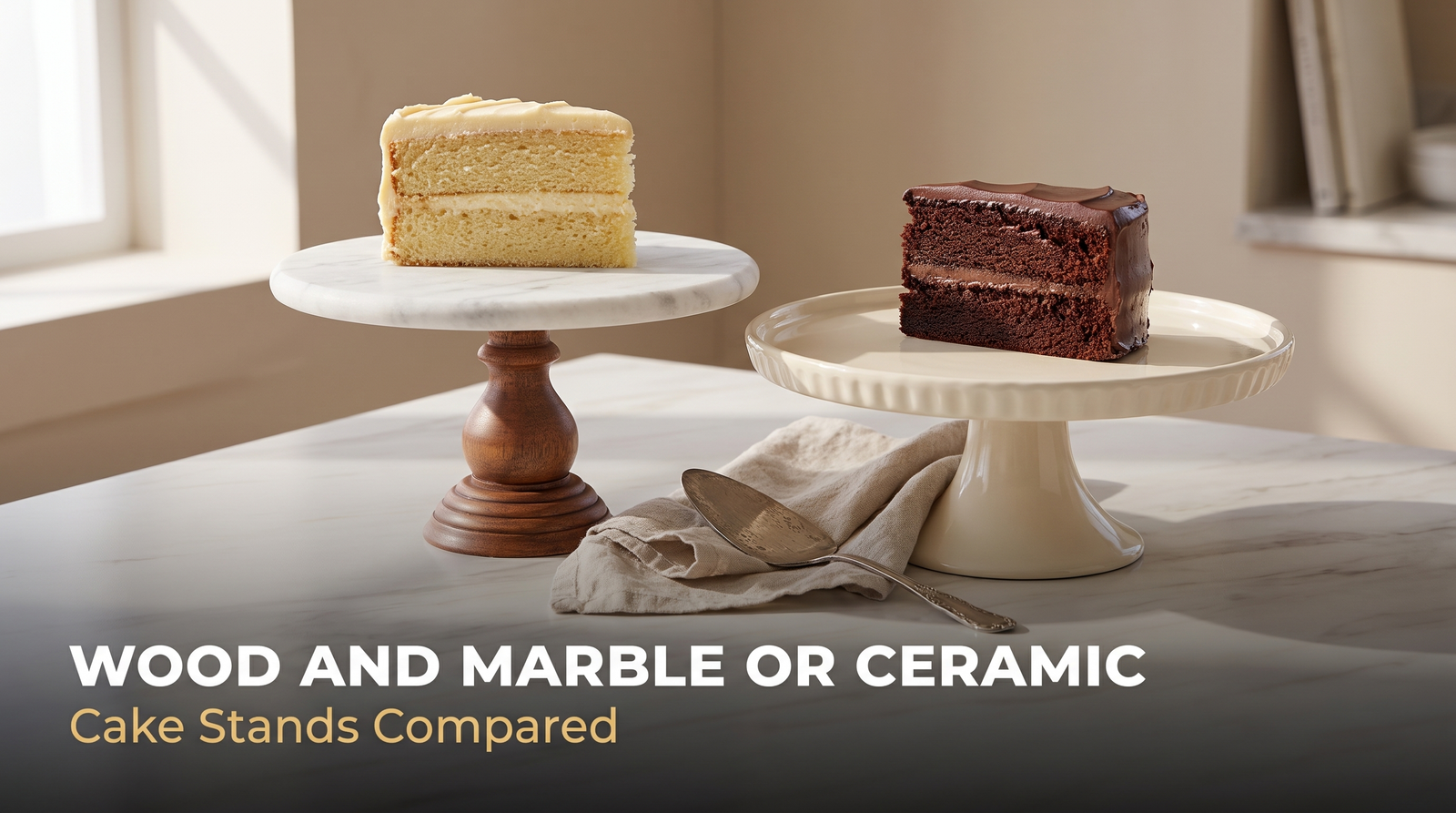
Ten against three. More than that, the ten cover genuinely different looks: raw farmhouse acacia, a polished marble plate, a marble-topped stand on a mango pedestal, a minimal acacia top on a black iron base, and a capsule-shaped marble platter that comes with a glass dome.
Salt & Pepper's three are all round pedestals within 28 to 30cm of each other. They are nicely done, but if the first one is not your style there are two more, and then you are finished.
Round 2 to Gleemium — more than three times the range, and more variety within it.
Round 3 · Price on the tag
Gleemium: $76 – $107, middle price $92 · Salt & Pepper: $59.99 – $89.99, middle price $84.99
Salt & Pepper takes this one, and it is not close at the entry point. The Quinn glass stand at $59.99 undercuts anything Gleemium sells by $16, and Salt & Pepper's dearest stand is cheaper than Gleemium's dearest.
If you want the lowest possible number on the tag, that is the answer and we are not going to argue with it.
Round 3 to Salt & Pepper — $59.99 beats $76.
Round 4 · Price delivered
Gleemium: free shipping Australia-wide, no minimum · Salt & Pepper: $11.95 flat under $99, free over $99
Here is the round that changes the picture, and it is the reason we ran it separately.
Salt & Pepper charges a flat $11.95 for standard shipping on orders under $99 anywhere in Australia. Gleemium ships free with no minimum. On a single cake stand, that $11.95 lands on every Salt & Pepper order except the Leif if you add something small to tip it over $99.
| Stand | Size | Tag price | Shipping | Delivered |
|---|---|---|---|---|
| Salt & Pepper Quinn, glass | 28cm | $59.99 | $11.95 | $71.94 |
| Gleemium Farmhouse Raw Acacia | 11.75 in ≈ 30cm | $76.00 | Free | $76.00 |
| Gleemium Classic Mango Wood | 10 in ≈ 25cm | $85.00 | Free | $85.00 |
| Salt & Pepper Riley, stoneware | 30cm | $84.99 | $11.95 | $96.94 |
| Gleemium Handcrafted Acacia | 12 in ≈ 30cm | $90.00 | Free | $90.00 |
| Salt & Pepper Leif, stoneware | 29cm | $89.99 | $11.95 | $101.94 |
Read the 30cm row against the 30cm row. A Salt & Pepper Riley lands at $96.94. A Gleemium Handcrafted Acacia at the same diameter lands at $90.00. The solid timber, hand-cut stand is the cheaper one on your doorstep.
The fair caveat: if you are already spending $99 or more at Salt & Pepper, shipping is free and this round is a draw. Buying a cake stand on its own is where the gap shows up.
Round 4 to Gleemium — cheaper delivered at every size except the very cheapest stand.
Round 5 · Can you actually buy it
Gleemium: 5 of 10 in stock (50%) · Salt & Pepper: 3 of 3 in stock (100%)
This is our weakest round and we are not going to dress it up.
Half of Gleemium's cake stand range was sold out on the day we checked, including the white marble stand on a mango base, the fusion mango and marble stand, and the acacia and iron stand. Because each piece is cut by hand and most listings carry a single unit, a sold-out stand may not come back in the same form.
All three Salt & Pepper stands were available. That is the advantage of a manufactured range — they can make more.
The five Gleemium stands that were in stock: Farmhouse Raw Acacia at $76, Classic Mango Wood at $85, Handcrafted Acacia at $90, the Marble and Wood Capsule Platter with glass dome at $92, and the resin set at $100.
Round 5 to Salt & Pepper — 100% beats 50%, clearly.
Round 6 · Everyday use
Gleemium: hand wash only · Salt & Pepper: dishwasher safe, hand wash recommended
All three Salt & Pepper stands state dishwasher safe on their product pages, with hand washing recommended. For a stand that has just held a cream cake, that is a genuine convenience.
Gleemium's wooden and marble stands must be hand washed. Sustained dishwasher heat and a long soak swell timber and then dry it unevenly, which causes splitting, and hot alkaline detergent will dull a polished marble surface. Our own listings say hand wash under cool water and pat dry.
That is a real cost of buying timber, not a detail to gloss over. Two minutes at the sink, every time.
Round 6 to Salt & Pepper — the dishwasher is a fair thing to want.

Round 7 · Twenty years from now
Gleemium: sand it back, re-oil it · Salt & Pepper: a chip is permanent
This is the round the whole comparison turns on.
Something will eventually go wrong. A knife will mark the surface. It will get knocked off a bench.
A scratched timber stand is a twenty-minute fix. Fine sandpaper, a wipe of food-safe oil, and the mark is gone — not hidden, actually gone, because you have removed a layer of the material and the material underneath is the same material. Marble can be re-polished by a stonemason for the same reason.
A chipped glaze cannot be repaired. The glaze is a fused glass layer over a clay body, and once it breaks you have exposed porous clay that will hold moisture and stain. Glue is visible and not food safe on a serving surface. The piece is decorative from that day on.
That is the difference between an object that gets better with maintenance and one that only gets worse.
Round 7 to Gleemium — repairable beats replaceable on something you keep.

Where Salt & Pepper genuinely beats us
Three things, said plainly.
- Everything is in stock. If you need a cake stand for Saturday, Salt & Pepper can supply one and half our range cannot.
- It goes in the dishwasher. No hand washing, no drying, no oiling once a year. For a busy household that is worth real money.
- The cheapest stand is cheaper. $71.94 delivered for the Quinn glass stand is under anything we sell, and glass has a genuine advantage of its own — it is endlessly recyclable and it never stains.
And one thing that is a draw, not a win for either of us. Salt & Pepper's stands say "Made in China" on the product page. Gleemium's are made in India. Neither of us is Australian-made, and if buying Australian-made is your priority, neither range is your answer — look for an Australian woodworker or potter instead. Worth adding that in the lifecycle study above, transport accounted for under 1% of total emissions, so distance from the factory matters far less than most people assume. What the thing is made of matters much more.
The one Gleemium stand that does not fit our own argument
We sell a hand-poured resin cake stand set at $100, and it is fair to point out that resin is a plastic. It is hand-poured by artisans over a 72-hour cure, so it is genuinely handmade, but it is not wood, it is not marble, and it cannot be sanded back or recycled.
If you are buying on the materials argument in Round 1, that is the one piece in our range it does not apply to. We would rather say so than let the average carry it.
Inches, centimetres, and picking the right size
A practical annoyance: Gleemium lists sizes in inches, Salt & Pepper in centimetres. Here is the conversion so you can compare like for like.
| Listed size | In centimetres | Suits |
|---|---|---|
| 10 inch | 25.4cm | A 20cm round cake, or a stack of cupcakes |
| 11 inch | 28cm | A 23cm round cake with room at the edge |
| 11.75 inch | 30cm | A 25cm cake, or a mixed dessert platter |
| 12 inch | 30.5cm | Layer cakes and larger celebration cakes |
The rule: leave 3 to 5cm of stand showing around your cake. A 20cm cake on a 20cm stand looks like a mistake. The same cake on a 25cm stand looks deliberate.
And check the weight. Gleemium's stands run from 740g for the mango wood one up to 4.6kg for the marble-and-mango stand. That heaviest one is a two-handed object and needs cupboard space to match. Salt & Pepper does not publish weights, so you cannot check this before buying.

Looking after each one
| Wood (Gleemium) | Marble (Gleemium) | Stoneware and glass (Salt & Pepper) | |
|---|---|---|---|
| Washing | Hand wash, cool water, dry straight away | Wipe with a damp cloth, do not soak | Dishwasher safe, hand wash recommended |
| Watch out for | Standing water and direct heat | Lemon, vinegar and anything acidic, which etch the polish | Knocks against hard edges |
| Maintenance | Food-safe oil once or twice a year | Optional stone sealer for stain resistance | None |
| If it gets damaged | Sand and re-oil | Re-polish | Cannot be repaired |
So which should you buy?
- You want it to last decades and you like timber. Gleemium. That is the whole argument of this article.
- You need it this week. Salt & Pepper. Half our range was sold out.
- You will not hand wash anything. Salt & Pepper. Be honest with yourself about this one.
- You want the cheapest possible stand. Salt & Pepper Quinn at $71.94 delivered.
- You want the best value at 30cm. Gleemium Handcrafted Acacia at $90 delivered, against $96.94 for the Riley.
- It is a wedding or a milestone gift. Gleemium, because each piece has its own grain and no two are the same.
- You want Australian-made. Neither. Find a local woodworker or potter.
Frequently asked questions
Is Salt & Pepper or Gleemium better for cake stands?
Gleemium wins four rounds to three on our scoring, which weights materials and lifespan most heavily. Gleemium takes materials, choice, delivered price and repairability. Salt & Pepper takes tag price, stock availability and dishwasher safety. If you need one this week or will not hand wash, buy Salt & Pepper.
How much do cake stands cost in Australia?
At these two shops on 26 September 2026, tag prices ran from $59.99 to $107. Delivered, that becomes $71.94 to $107 once Salt & Pepper's $11.95 flat shipping under $99 is added. Gleemium ships free with no minimum.
Are Salt & Pepper cake stands made in Australia?
No. All three cake stands state "Made in China" on their product pages. Gleemium's are made in India. Neither range is Australian-made.
Can you put a wooden cake stand in the dishwasher?
No. Sustained heat and a long soak swell the timber and then dry it unevenly, which causes splitting and cracking. Hand wash in cool water and dry it straight away. Salt & Pepper's stoneware and glass stands are dishwasher safe.
Which lasts longer, a wooden or a ceramic cake stand?
Both last a long time if nothing goes wrong. The difference is what happens when something does. A scratched wooden stand can be sanded back and re-oiled and the mark is genuinely gone. A chipped glaze exposes porous clay underneath and cannot be repaired, so the piece becomes decorative.
What size cake stand do I need?
Leave 3 to 5cm of stand showing around the cake. A 20cm cake suits a 25cm stand, and a 25cm cake suits a 30cm stand. Measure the tin you actually bake in rather than guessing from photos.
Is a wooden cake stand more eco-friendly than a ceramic one?
On manufacture, generally yes. Acacia and mango are grown rather than fired, and mango timber is a by-product of fruit farming. Stoneware is fired at roughly 1,100 to 1,300°C, and research on tableware production found manufacturing accounts for about 73 to 77% of a piece's emissions. But a ceramic stand kept for twenty years spreads that impact thinly, so the more useful question is how long you will keep it and whether it can be fixed.
Do Gleemium cake stands come with a dome?
One does. The Marble and Wood Capsule-Shaped Cake Platter at $92 includes a glass dome. The Solid White Marble Cake Plate does not — its listing says the dome is not included.
Sources
- Gleemium — Cake & Tiered Stands collection, 10 listings checked 26 September 2026
- Salt & Pepper — Cake Stands collection and individual product pages for Riley, Leif and Quinn, checked 26 September 2026
- Salt & Pepper — shipping rates and country of manufacture, stated on each product page, 26 September 2026
- Journal of Design Research — Carbon footprint and specific energy consumption of tableware products (firing dominates ceramic manufacturing emissions; transport under 1%)
Prices, stock and shipping terms were checked on 26 September 2026 and will change. Confirm on each shop's own site before you buy. Gleemium publishes this blog and wins this comparison on our stated weighting; the three rounds Salt & Pepper wins are reported in full, our 50% sold-out rate is stated plainly, and we have flagged the one stand in our own range that does not fit our materials argument.